
Seeking the Sword of All Work: What is a Good All-Purpose Japanese Knife?
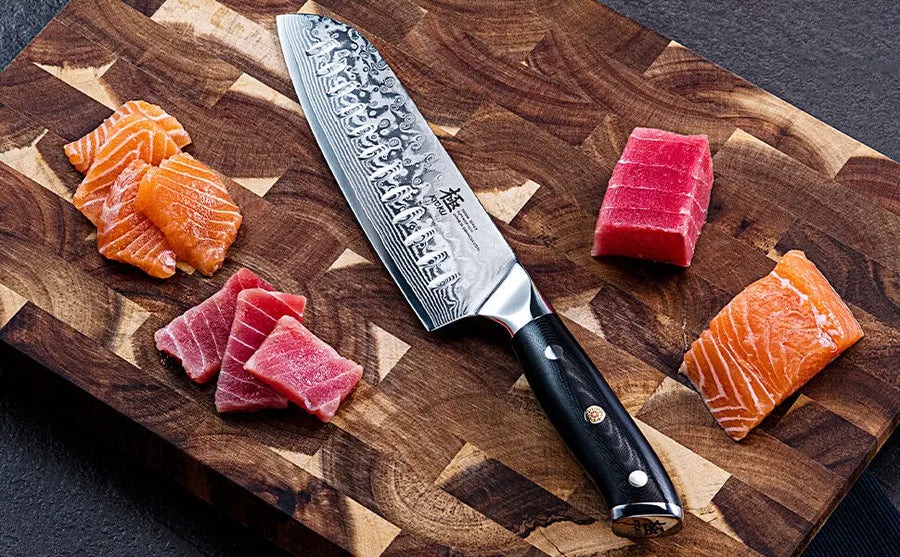
Walking into a kitchen with a massive block of twenty specialized knives looks impressive on a cooking show. But in reality, whether you are a Michelin-starred chef or a passionate home cook, you spend 90% of your time reaching for just one reliable daily driver.
At Kyoku kitchen knife, we draw from the Samurai legacy—a heritage where a warrior didn’t carry a dozen swords; they carried the one they trusted implicitly with their life. In the culinary world, you need that same level of trust in an all-purpose knife.
If you are looking to invest in your first high-end Japanese knife but want a single blade that can handle everything from morning vegetable prep to evening protein slicing, you are looking for either a Gyuto or a Santoku knife.
Let’s help you find your perfect all-purpose companion.
The Two Titans of Versatility
When it comes to multi-tasking on the cutting board, Japanese cutlery offers two masterfully engineered options. While both feature Kyoku’s signature high-carbon steel and razor-sharp 13–15° edge angles, they approach the culinary battlefield with different styles.
1. The Gyuto: The Japanese Chef’s Knife
The word Gyuto literally translates to “beef sword,” but don’t let the name fool you—this is the ultimate western-style crossover. It is the closest cousin to the traditional French or German chef’s knife, reimagined with elite Japanese engineering.
- The Profile: It features a long, elegant blade with a distinct curve (or “belly”) near the tip and a sharp, piercing point.
- Why it’s a great all-purpose choice: The length (typically 8 inches) gives you immense leverage to slice through large primal cuts of meat, dense watermelons, or heavy spaghetti squash. Meanwhile, the curved edge allows you to employ the classic Western rocking motion to rapidly mince herbs and garlic.
2. The Santoku: The “Three Virtues” Companion
If the Gyuto is a sword, the Santoku is a tactical dagger. Its name literally means “three uses” or “three virtues,” explicitly celebrating its mastery over slicing, dicing, and mincing.
- The Profile: It has a shorter, flatter blade with a blunt, downward-curving “sheep’s foot” tip.
- Why it’s a great all-purpose choice: Because the blade is flatter, it excels at a vertical push-cutting motion. It makes 100% flat contact with the cutting board, ensuring you never end up with “accordion vegetables” (where slices stay connected by a tiny thread). Its compact size (usually 5 to 7 inches) makes it incredibly agile, light, and less intimidating for everyday home cooking.
Gyuto vs. Santoku: At a Glance
To help you decide which all-purpose style fits your hands, look at how they stack up side-by-side:
| Feature | The Kyoku Gyuto | The Kyoku Santoku |
| Blade Length | Long (8 – 10 inches) | Compact (5 – 7 inches) |
| Cutting Technique | Rocking, slicing, piercing | Push-chopping, rapid dicing |
| Weight Distribution | Balanced, forward-leaning leverage | Centered, nimble, lightweight |
| Ideal Ingredients | Large proteins, large root vegetables | Vegetables, boneless meats, fish |
| Kitchen Size | Great for spacious counters | Perfect for cozy or compact spaces |
The Kyoku Difference: Why Our All-Purpose Blades Stand Out
Whichever path you choose, a Kyoku all-purpose knife brings professional-grade metallurgy to your kitchen at an affordable price.
“True culinary creativity begins the moment your tool disappears and becomes a natural extension of your hand.”
Every Kyoku Gyuto and Santoku is crafted with:
- Premium Japanese Steel: We use ultra-hard cores (like VG-10) treated with cryogenic nitrogen cooling to achieve a 60+ Rockwell Hardness (HRC). This means your all-purpose knife stays razor-sharp for months, not days.
- The Granton Edge: Many of our multi-purpose blades feature scalloped indentations along the edge. These create tiny air pockets, preventing starchy potatoes or sticky cucumbers from clinging to the blade while you work.
- Ergonomic G10 Handles: Our military-grade handles offer a non-slip grip that is impervious to heat, moisture, and kitchen chaos.
The Verdict: Which One Should You Choose?
- Choose the Kyoku Gyuto if you cook in large volumes, frequently prepare large cuts of meat, or prefer the traditional Western rocking technique.
- Choose the Kyoku Santoku if you want a nimble, lightweight blade for a vegetable-heavy diet, work in a smaller kitchen, or prefer a clean, vertical chopping motion.
Investing in a high-quality all-purpose Japanese knife isn’t just an upgrade to your kitchen hardware—it’s an investment in your culinary passion.